
SalaryTalent: Right Diagnosis, Ambitious Prescription
For 27 years, Salary.com has been one of the default answers to a very specific question: what should we pay for this job? As of this week, it would also like to answer who should we hire, how did they do, and who's covering Tuesday's second shift.
That's SalaryTalent, a new platform launching with five products: Recruiting, Candidate Sourcing, Performance Management, Workforce Management, and an HR agent orchestration layer. The pitch is "compensation-first talent management." CEO Yong Zhang's framing is one I'd happily put on a mug: "Start from the value of work, and everything downstream gets better."
So, let's unpack this a bit. I'll come at this from a skeptical point of view, and purely from the voice of a compensation practitioner. I'm not the right person to judge the quality of a recruitment application in itself. But I do feel qualified to express the potential concerns a compensation leader may bring to the table.
A note before we dig in: I haven't had a briefing or demo yet. Everything here comes from the launch announcement and product pages, and I'm happy to update my view once I've seen the product.
The diagnosis is right
Anyone who has worked in comp knows the moment. The offer has been verbally extended, the hiring manager is thrilled, and someone finally asks comp whether the number fits the range. Pay really is the last field filled in.
Requiring a salary range before a requisition opens is exactly the guardrail comp teams have wanted from recruiting systems since the first transparency laws landed. Putting base, bonus, commission, and equity into one offer workflow with market context is sensible. And 1.4 million leveled titles isn't something a startup spins up over a long weekend.
If the question is whether comp intelligence should show up where talent decisions happen, the answer is yes. Candidly, that's been the promise of CompTech for a decade.
The ontology question
Salary.com leans hard on a particular word: ontology. They've told me directly that what they've built is an ontology, not a taxonomy, and the term shows up in most coverage of this launch because it's their term.
For anyone who hasn't had to care about the difference, a taxonomy sorts things into buckets: this job lives in this family at this level. An ontology also maps how things relate: this job requires these skills, pays this much in this market, and leads to these next roles. That's the right structure for SalaryTalent, because candidate matching, career paths, and offer guidance all depend on those relationships.
The ontology is robust, but its longevity can also be a driver of complexity. It was first designed for a world of work that looked very different 27 years ago, and sometimes it shows. Salary does a very good job of listening to customers and refining its methods, but there are elements of the framework that can be difficult to use in reality. Comp teams live with this because we've always translated our jobs into benchmark jobs. Matching is half the work. Recruiters and employees won't be so patient. Nobody puts "Accountant III" in their LinkedIn headline, and a career path that runs from III to IV isn't much of a career conversation if the underlying description is pretty similar.
The risk may be that in SalaryTalent, recruiters and employees see the ontology raw, with no comp analyst in between to translate. Extending the ontology into talent decisions doesn't just leverage the asset. It exposes it.
The quality of the skills layer in any database, including Salary.com's, is a work in progress. In most cases, "skills" are largely keywords pulled from job descriptions, which is not the same thing as skills the market actually pays a premium for. That last one matters, because skills priced against the market is a headline feature of the new Performance product.
Data, Design, Delivery
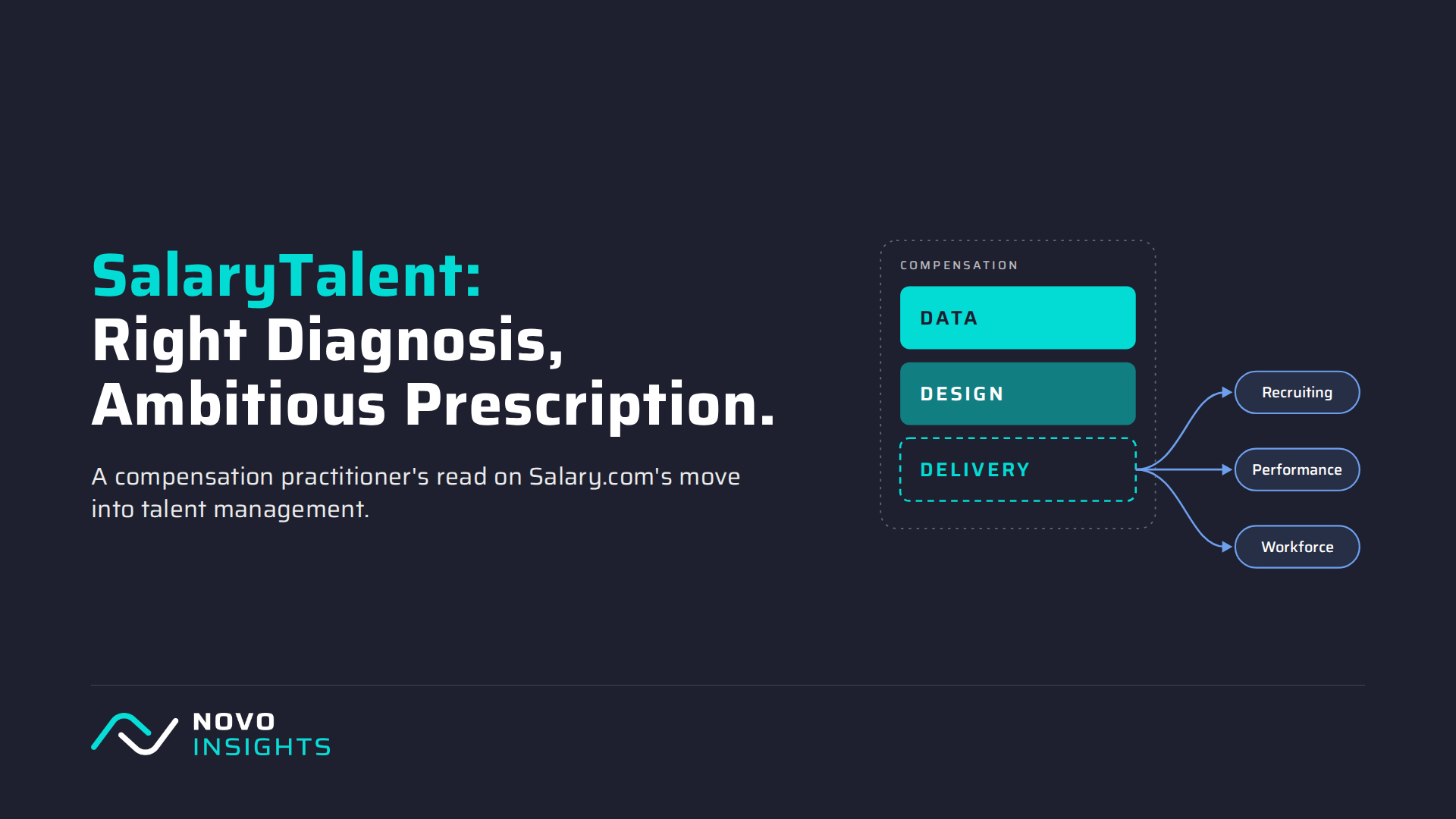
In the CompTech Index, we sort the market into three layers. Data is the underlying benchmarks, whether that's full population benchmarking, recent offers, or predictive models. Design is structures, job architecture, and modeling. Delivery is getting pay decisions made and communicated: cycles, manager tools, statements.
Salary.com has been a heavyweight in Data for a long time, and CompAnalyst is a leader in Design. Delivery has been the weaker leg, even with CompXL and Elevate in the portfolio.
SalaryTalent is a Delivery bet, and the interesting part is where it delivers. It doesn't go deeper into comp, into merit cycles and manager experience where the gap has been. It goes outward into recruiting, performance, and scheduling, where the buyers are different and the incumbents are entrenched. Instead of renovating the kitchen, they're building an addition.
The prescription is a lot of surgery
The question isn't whether comp belongs in talent decisions. It's whether the comp data provider should own the decision process. That runs into three potential points of friction for Salary.
1. The buyer isn't the one who trusts the data
We've been skeptical before when rewards vendors reach outward, and I'll stay consistent. Data gravity pulls hardest on the people who already rely on the data, and that's the comp team. TA leaders buy an ATS on candidate experience, job board reach, and time-to-fill. Operations leaders buy scheduling on shift coverage and whether a store manager can use it at 5:45 a.m. Neither wakes up thinking about survey methodology or an ontology.
The launch pages give this away a bit. Recruiting and Candidate Sourcing were written for recruiters and hiring managers. Workforce Management reuses the platform's core persona block: CHRO, Total Rewards, CFO, Legal. No scheduler. No ops leader.
What that practically means is that the land-and-expand path runs through the comp leader. Asking your comp champion to sell an ATS to the head of TA means spending political capital most comp teams don't have to spare.
2. The brand just told us what they are
This spring, Salary.com refreshed its brand alongside its Max AI launch, and the new logo simply reads "Salary." The company still goes by Salary.com, but the logo is the part designed to say who you are, and it says pay. Six months later, it launched shift scheduling and performance feedback.
A new category means a new pitch, new personas, and new product requirements: job board integrations, scheduling UX, leave compliance content. Those reconcile only if the story becomes "pay is the lens for every workforce decision." That's an easier sell to a CFO than to a scheduling buyer.
3. Partners are about to become competitors
In August, Salary.com announced a Workday Design Approved integration. Five weeks later, it launched recruiting that includes Core HR, onboarding, and self-service. Workday, meanwhile, has spent two years assembling its own AI talent acquisition suite. Everyone in HR tech partners and competes at the same time. That's the job.
The sharper exposure isn't Workday, though. SalaryTalent's initial target is organizations of roughly 250 to 3,000 employees. That's where ADP, UKG, Dayforce, and Paylocity live, and those are the names on Salary.com's own integrations page. Workforce management is UKG and Dayforce's home turf. And Salary.com runs a data-as-a-service program that pipes its data into other people's systems.
You can be the arms supplier, or you can field an army. Doing both requires very relaxed partners and very carefully managed alliances.
The comp fine print
Two things practitioners should look at closely.
First, Candidate Sourcing puts an estimated current salary on external candidate profiles so recruiters know who they can realistically hire. Useful, perhaps. It's also in some tension with "start from the value of work" since it deliberately anchors on a value for a candidate, not the work. This runs the risk of being a shadow version of asking for salary history, and such bans exist to keep prior pay from anchoring the offer. An estimate isn't the same as asking, but comp leaders should decide how recruiters use that number before recruiters decide for them.
Second, the Performance pitch is that ratings flow straight into pay. The page puts it plainly: "A review that doesn't reach a pay decision is just a form." Plenty of organizations have deliberately loosened that link. Some separate development conversations from pay conversations; others have moved away from formula-driven merit matrices. Tight coupling is a philosophy, not a feature. Make sure the software matches yours.
So what do we do about it?
If you're a mid-market organization already on CompAnalyst and consolidating tools, here's how I'd evaluate this the right way:
Have TA run the recruiting evaluation and ops run the WFM evaluation. If comp is the only team excited, that's your answer.
Test the connection, not the module. The value is range and market context at the moment of decision. Compare that against integrating CompAnalyst or your manual pay bands into the ATS and performance tools you already run.
Pressure-test the ontology on your own jobs. Search for your newest roles by the titles you actually use, and look at the career paths it suggests for a few real employees.
Write down your pay-for-performance philosophy before the demo. Software has a way of becoming the philosophy.
At the end of the day, I'm glad to see a comp-native company swing big. Competition is good for practitioners, and this will push the HCM suites to take pay context more seriously. Salary.com is right that pay is the foundation. But nobody tours a house to admire the foundation. The real question is whether buyers who never think about foundations will move in.
Disclosure: My Totally Rewarding Chats co-host, Sean Luitjens, was VP of Strategy and Partnerships at Salary.com until early September 2026. He did not contribute to this piece in any way. Novo was not briefed on SalaryTalent and was not paid for this post.
This article is also posted on LinkedIn - check it out and engage in the discussion.